
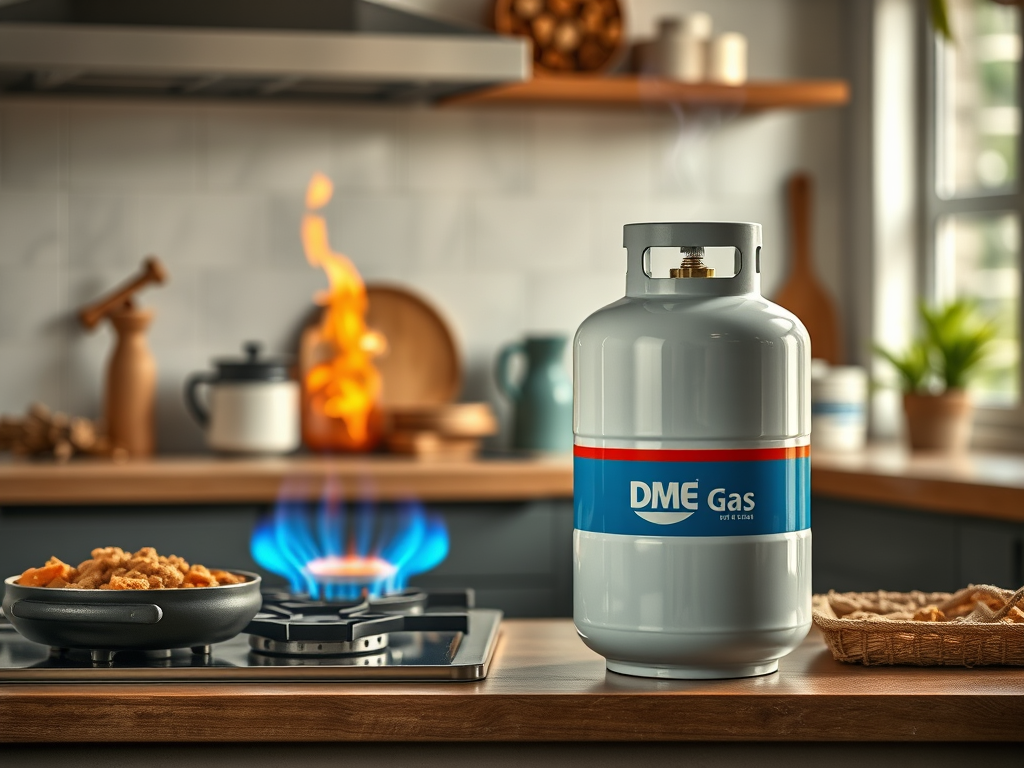
Simple, cleaner, and surprisingly practical—here’s what you should know
A new gas that will replace LPG? Yes, it’s real.
For decades, LPG has been the backbone of Indian kitchens. It’s reliable, familiar, and widely available.
But with rising fuel prices and environmental concerns, researchers have been exploring alternatives. One option gaining attention is DME gas, also known as dimethyl ether.
The idea of a DME gas alternative to LPG might sound futuristic. However, it’s already being tested in multiple countries, including India.
So what exactly is DME gas? And could it really replace LPG in your kitchen?
Let’s break it down in the simplest way possible.

What Is DME Gas (Dimethyl Ether)?
DME stands for dimethyl ether, a clean-burning fuel made from natural gas, coal, or even biomass like agricultural waste.
In simple terms:
- It’s a gas that behaves a lot like LPG
- It can be stored in cylinders
- It burns cleanly with very little smoke
From a user’s perspective, it feels almost identical to LPG.
But chemically, it’s different—and that difference brings some important advantages.
How DME Gas Works (Simple Science)
Let’s keep this easy.
When you burn LPG, it releases energy along with some pollutants like carbon monoxide and soot.
DME gas burns more efficiently because:
- It contains oxygen in its chemical structure
- It produces almost no soot
- It emits lower harmful gases
Think of it like a cleaner flame.
That’s why scientists consider the DME gas alternative to LPG a strong candidate for future cooking fuel.
How Was DME Gas Discovered and Developed?
DME isn’t brand new.
It was first studied decades ago as an industrial chemical. But only recently has it gained attention as a fuel.
Why now?
Because of three major shifts:
- Rising global fuel costs
- Push for cleaner energy
- Better technology to produce DME at scale
Countries like Japan, China, and India have started pilot projects to test DME as a replacement fuel for LPG.
In India, research institutions and energy companies are exploring how DME can be produced using:
- Coal reserves
- Biomass waste
- Industrial by-products
This makes it particularly relevant for India’s energy future.
Why DME Gas Could Replace LPG
Now let’s talk about the practical side.
Why are experts even considering a DME gas alternative to LPG?
1. Cleaner for the environment
DME produces:
- Almost zero particulate matter
- Lower nitrogen oxide emissions
- No sulfur content
This means cleaner air—especially important in cities and indoor kitchens.
2. Can be made from local resources
Unlike LPG, which India largely imports, DME can be produced locally using:
- Coal
- Agricultural waste
- Biomass
This reduces dependency on imports.
3. Works with similar infrastructure
DME can be stored in cylinders like LPG.
However, small modifications are needed in:
- Valves
- Rubber seals
- Burners
But overall, the transition is easier compared to switching to completely new energy systems.
4. Potential cost benefits
If produced at scale in India, DME could:
- Reduce fuel costs
- Stabilize price fluctuations
- Make cooking gas more affordable for middle-class families
What It Means for Indian Kitchens
This is the part most people care about.
How does this affect daily cooking?
Cooking experience
DME produces a blue flame, similar to LPG.
That means:
- Fast cooking
- Even heat
- No major change in cooking style
Safety
DME is actually considered safer in some ways because:
- It disperses quickly in air
- It has lower toxicity
- It produces less harmful smoke
However, like any fuel, proper handling is still essential.
Cylinder usage
Households may still use:
- Gas cylinders
- Regulators
- Stoves
But manufacturers may introduce DME-compatible appliances over time.
For rural and urban homes
DME has strong potential for:
- Urban households (cost + cleaner fuel)
- Rural areas (locally produced energy)
It can support government initiatives for cleaner cooking fuel access.
Challenges Before DME Becomes Mainstream
Even though the DME gas alternative to LPG looks promising, there are some challenges.
Infrastructure changes
Existing LPG systems need slight modifications to handle DME safely.
Production scale
India needs large-scale DME production plants to make it affordable.
Awareness
Most people haven’t even heard of DME yet.
Adoption will depend on:
- Government support
- Public awareness
- Industry participation
Is India Already Working on DME?
Yes.
India has already started pilot programs and research projects to test DME blending with LPG.
Some proposals suggest mixing DME with LPG in small percentages initially, which helps:
- Reduce emissions
- Lower costs
- Ease transition
Over time, this blend could increase.
Should You Expect DME Soon?
Not immediately—but it’s closer than you think.
In the next few years, you may see:
- Pilot distribution in select cities
- Blended LPG cylinders
- Government-backed schemes
The shift will likely be gradual, not sudden.
Final Thoughts
The idea of replacing LPG may sound ambitious.
But the DME gas alternative to LPG offers something rare:
- Cleaner fuel
- Local production potential
- Minimal lifestyle disruption
For Indian households, this could mean more affordable and eco-friendly cooking without changing daily habits.
It’s not about replacing LPG overnight.
It’s about evolving toward something better—step by step.
And DME might just be one of those steps.
More – Research result
Leave a Reply