
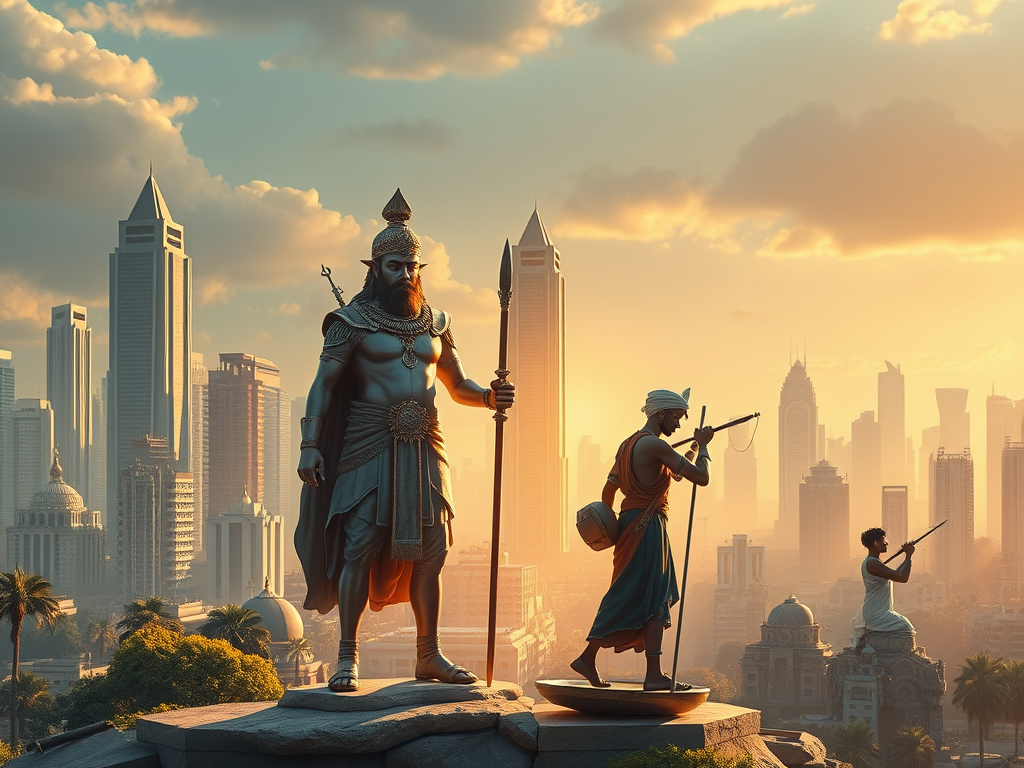
How would you design the city of the future?
A perfect city, in the conventional sense, is likely an impossible dream. But what about a good city? A harmonious, functional, and truly sustainable society? For millennia, we have searched for the principles to achieve this, often looking to modern economics and politics. What if the answer lies not in the future, but in a philosophy forged in the distant past?
Ancient Indian texts offer a fascinating and often misunderstood framework for a balanced society, centered on four archetypes of human nature. It’s crucial to understand that these are not the rigid, birth-based castes that later corrupted society. Instead, they are four fundamental pillars, representing different states of mind and natural inclinations, which when working together, form a cohesive whole.
Let’s explore these four pillars. We should examine how their balanced interaction could serve as a timeless blueprint for building a better city today.
The Four Pillars of a Good Society
- The Thinker (Brahman): The Guide
- This is the person whose primary focus is the accumulation of knowledge, wisdom, and ethical insight. Their purpose is to understand what is truly good for humanity and the environment, not for personal gain.
- Their Role: They act as the city’s conscience. When a new technology or policy is proposed, the Thinker provides a comprehensive analysis of its long-term effects—on the people, the planet, and future generations—guiding decisions with wisdom and foresight.
- The Protector (Kshatriya): The Leader
- This is the person with the courage, strength, and integrity to lead and defend the community. They are physically capable and possess a strong sense of duty to protect the vulnerable.
- Their Role: They are the decision-makers and implementers. The Protector listens to the Thinker’s advice, assesses the situation on the ground, and has the fortitude to make the final, crucial decision for the good of the society.
- The Provider (Vaishya): The Innovator
- This is the person with a natural talent for commerce, trade, and enterprise. They are skilled at creating, managing, and distributing the goods and services that keep the city running.
- Their Role: They are the city’s economic engine. Once a decision is made, the Provider mobilizes resources, manages logistics, and builds the infrastructure necessary to bring a new plan to life, ensuring the city’s material well-being.
- The Worker (Shudra): The Backbone
- This is the person whose natural inclination is to serve and contribute through labor and skill. They are the essential hands-on builders, artisans, farmers, and technicians who turn plans into reality.
- Their Role: They are the bedrock of the entire system. Without the dedicated effort of the Worker, no project, no matter how well-planned, can succeed. Their value lies in their direct action, implementation, and tireless contribution to the community’s daily function.
A Modern Example: From Discovery to Delivery
Let’s apply this ancient model to a modern scenario. Imagine a scientific breakthrough—a new form of clean, nuclear energy.
- The Thinker (a group of scientists, ethicists, and philosophers) would analyze the long-term environmental, social, and safety implications of this new energy source. They would present their findings and a balanced recommendation.
- The Protector (a city council or community leader) would take this expert advice and, based on the needs and safety of the people, decide whether to adopt the technology.
- The Provider (an entrepreneur or business leader) would then procure the necessary materials, secure funding, and manage the construction of the new power plant.
- The Worker (engineers, laborers, and skilled technicians) would be the ones to build, operate, and maintain the plant, making sure the energy flows to every home.
The Secret to Harmony
The genius of this framework is not in a hierarchy, but in its interdependence. Each role is vital and equally valuable. A Thinker without a Protector’s courage is powerless. A Protector without a Worker’s labor cannot build anything. The health of the entire society depends on the mutual respect and collaboration between these four pillars. No one is superior or inferior; they are simply different parts of the same living, breathing organism.
By recognizing and valuing these natural human tendencies and fostering a culture of cooperation, we can move beyond the endless conflicts of our time. We can create not a “perfect city,” but a good one—a society where every individual’s unique nature contributes to the collective good, guided by timeless wisdom.
Leave a Reply