
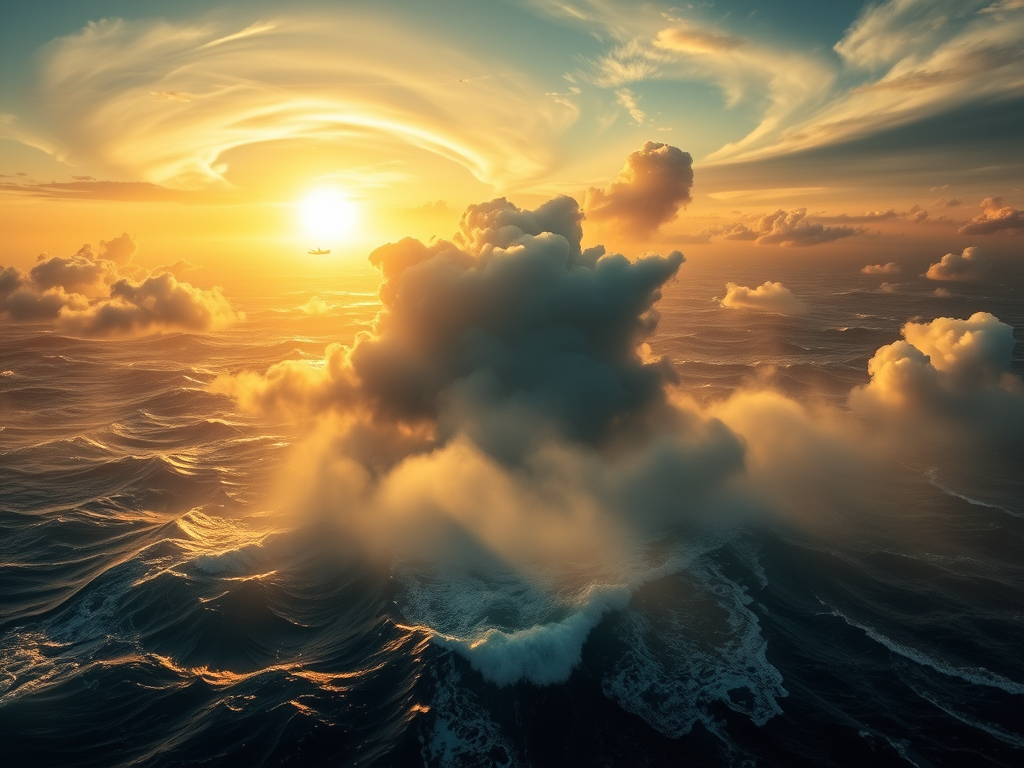
The Bermuda Triangle Mystery: Separating Science from Supernatural
The Bermuda Triangle, also known as the Devil’s Triangle, is a name that sends a shiver down the spine of sailors and aviators alike. This loosely defined region in the western North Atlantic Ocean, roughly bounded by Miami, Bermuda, and Puerto Rico, has been the center of an urban legend for decades, one filled with tales of ghostly ships, time warps, and extraterrestrial abductions.
But in an age of advanced satellite technology and sophisticated oceanographic research, is the Bermuda Triangle still an unsolvable enigma, or has science finally begun to pull back the veil on its grim reputation? Let’s take a deep dive into the history, the folklore, the popular theories, and the latest scientific advancements that are finally providing answers.

The History of a Modern Myth
The legend of the Bermuda Triangle is surprisingly recent. While tales of strange happenings in the region date back to Christopher Columbus’s journals, the term “Bermuda Triangle” wasn’t coined until 1964 by writer Vincent Gaddis. The myth truly exploded into popular culture with the 1974 bestseller The Bermuda Triangle by Charles Berlitz, a book that sensationalized the disappearances, often ignoring the very real weather conditions or historical facts behind each incident.
Over the years, hundreds of ships and planes have been added to the list of “mysterious” disappearances, including some of the most famous cases:
- USS Cyclops (1918): A massive US Navy cargo ship vanished with 306 crew members and passengers. The incident remains one of the largest non-combat losses in US naval history.
- Flight 19 (1945): This is perhaps the most famous case. A squadron of five US Navy torpedo bombers on a training mission disappeared. What’s even stranger is that the rescue plane sent to find them also vanished.
These are just two examples among many that fueled the public’s fascination with the paranormal.
The Popular Theories: From Alien Abduction to Sunken Atlantis
The lack of debris or survivors in many of these cases created a vacuum of information, which was quickly filled by a host of imaginative and supernatural theories.
- Paranormal Activity: The most common theories suggest a portal to another dimension, a time vortex, or even a parallel universe exists in the Triangle, sucking in unsuspecting vessels.
- Aliens & UFOs: The idea of extraterrestrials abducting ships and planes for unknown purposes has been a popular explanation for decades.
- The Lost City of Atlantis: Some believers tie the disappearances to the mythical sunken city of Atlantis, suggesting that powerful energy crystals left over from its technology disrupt modern navigation and electronics.
While these stories make for great entertainment, they fail to stand up to scientific scrutiny.
Latest Advancements: Science Over Superstition
Over the past few decades, a new generation of scientists and skeptics have worked to provide logical explanations for the so-called mysteries of the Bermuda Triangle. Their findings are backed by data from satellite imagery, oceanographic research, and meteorological records.
- Rogue Waves: This is one of the most compelling and recent theories. Dr. Simon Boxall, an oceanographer at the University of Southampton, argues that rogue waves—massive, unpredictable walls of water that can reach nearly 100 feet in height—are the most likely culprit for many sinkings. These waves form when multiple storms converge, creating a deadly, sudden force that could snap a large ship in half. His team’s simulation of the USS Cyclops’s sinking showed that such a wave could overwhelm the vessel in minutes, leaving no time for a distress call.
- Methane Hydrates: Another intriguing theory, known as the “Clathrate Gun Hypothesis,” suggests that pockets of methane gas trapped under the seafloor could be responsible. A sudden geological shift could release this gas, which would bubble to the surface. This would drastically reduce the water’s density, causing ships to lose buoyancy and sink instantly. The gas could also affect the air, potentially causing an aircraft’s engine to stall. While this is a plausible theory, there is no definitive evidence to link it to the Triangle’s disappearances.
- Human Error and Environmental Factors: The most widely accepted explanation among organizations like the U.S. Navy and the National Oceanic and Atmospheric Administration (NOAA) is far less dramatic. The Bermuda Triangle is one of the busiest and stormiest shipping lanes in the world. It is prone to sudden, violent storms, hurricanes, and the swift currents of the Gulf Stream. When you combine these natural hazards with human error, faulty equipment, and the fact that most incidents happened before modern GPS and distress beacon technology, the “mystery” becomes a lot more mundane.
The Verdict: A Manufactured Mystery
Ultimately, statistical analyses by reputable sources like Lloyd’s of London and the U.S. Coast Guard show that the number of disappearances in the Bermuda Triangle is not disproportionately higher than in any other heavily-trafficked, storm-prone part of the ocean.
The Bermuda Triangle, therefore, is not a supernatural anomaly but a product of natural hazards, human fallibility, and decades of exaggerated storytelling. While the legend may continue to capture our imaginations, the real truth is a powerful reminder that the forces of nature, not the paranormal, are often the greatest dangers faced at sea.
More – https://en.wikipedia.org/wiki/Bermuda_Triangle
Leave a Reply